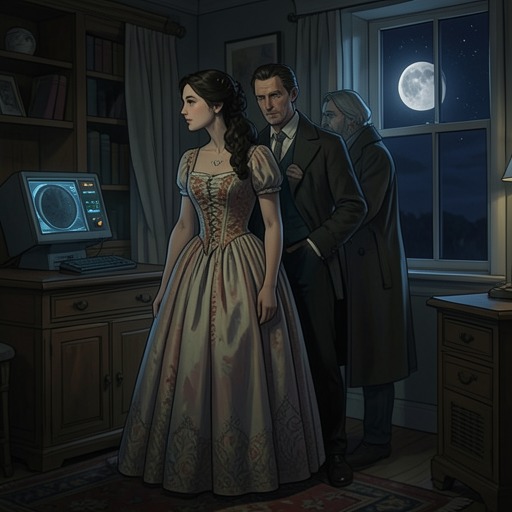
Merricat’s attempt to drive Charles away
We Have Always Lived in the CastleMary Katherine Blackwood’s attempt to drive Charles Blackwood away turns a family conflict into a campaign against his physical presence and the objects that make the Blackwood house recognizable to him. She first asks him to leave, then tries to erase his influence through acts of magical protection and deliberate alteration. The campaign is precise in its rituals but cannot compel Charles to go: his refusal pushes Mary Katherine from watching and planning toward dismantling the familiar rooms themselves.
The Breach and the Choice of a Tactic
Mary Katherine understands Charles’s entry as evidence that the protection around Constance Blackwood has failed. The mirrors sparkle, their mother’s diamonds and pearls shine in the dark, and new leaves move outside; these vivid signs of the house’s ordinary beauty contrast with the threat she perceives inside it. If she can reseal the protection and shut Charles out, she believes, he will have to leave. Every touch he makes on the Blackwood house must be erased. She polishes the doorknob to her father’s room, counting the removal of even one of Charles’s touches as a small restoration of safety.
But restoration is not enough. Mary Katherine considers which device could drive Charles away without bringing still worse disaster. Their mother’s jewels seem powerful only on a bright day, and Constance has decided not to take them from their box. Books usually protect strongly, but their father’s book fell from a tree and let Charles in; to Mary Katherine, that failure makes books suspect. She settles on a conditional plan: if Charles has not gone after three days, she will smash the hall mirror. Her caution matters as much as her hostility. In her view, magic must be exact; an imperfectly chosen or wrongly used instrument may compound the danger.
Refusal and Escalation
Mary Katherine eventually addresses Charles directly and asks him to go away. He agrees only that she has asked, then refuses the request. His possession of family property sharpens the exchange: he wears their father’s gold watch chain, including its crooked link, and Mary Katherine knows the watch is in his pocket. She imagines him next wearing the signet ring and making Constance put on their mother’s pearls. The objects are not merely heirlooms in her account; Charles’s use of them makes his arrival feel like an occupation of the family’s intimate spaces and history.
Charles also turns the question of who belongs into a threat, wondering aloud who will still be there a month later. Mary Katherine has no further answer. She runs upstairs and strikes the mirror over the dresser in her father’s room with a shoe until it cracks across, then falls asleep at the window. The act follows her earlier plan to use a mirror, but its force is personal and immediate: rather than merely prepare a future device, she damages an object in a room already associated with Charles’s appropriation.
Undoing Charles’s Footprint
On Thursday, which Mary Katherine considers her most powerful day and the right time to settle matters with Charles, she enters her father’s room quietly while the others are occupied. Charles has started the watch. Mary Katherine finds it with its chain and the signet ring on the dresser, beside Charles’s tobacco pouch and four books of matches. She cannot turn the watch back to its former time after it has run for two or three days, so she twists the winding knob backward until the mechanism gives a small crack and stops. She puts it back where she found it, regarding the silenced watch as something released from Charles’s spell.
She then makes the room unfamiliar. During the night she has gathered a basket of wood, broken sticks, leaves, glass, and metal from the field and woods. She removes books from the desk and blankets from the bed, carries the family’s things to the attic where their possessions are kept, and pours water over the bed so Charles cannot sleep there again. The mirror is already smashed; books and clothes are gone. She fills their places with the collected debris and tears down the curtains, leaving the view of the driveway and road exposed. In her reasoning, Charles will be cut off from what he recognizes and will have to concede that this is no longer the house he came to visit. His shout from the garden that the arrangement is too much shows that the change has reached him, though it does not show that he has been driven out.
Mary Katherine’s smaller acts of removal extend the same struggle over domestic objects. When she finds a saucer and Charles’s pipe in a bedroom, she brushes both into a wastebasket; the saucers, once stored on a pantry shelf, have been scattered through rooms of the house. The gesture is modest beside the ruined bedroom, but it belongs to a wider pattern: things displaced from their proper places become signs of Charles’s reach, and removing or relocating them becomes a way to contest that reach.
Damage, Ash, and the Limits of Protection
The later wreckage of the Blackwood house gives the campaign’s language of contamination and threatened order a harsher material setting. After the house has burned and intruders have ransacked it, Constance and Mary Katherine find the kitchen obstructed by a table turned on its side. Chairs, dishes, food, and generations of household silver are broken or scattered; jam and syrup have been smashed against the walls, and the little rose-covered sugar bowl lies with its handles gone. The cellar preserves are untouched, but the pantry shelves have been searched and food trampled. Mary Katherine thinks of the intruders finding the sugar and playing with it, connecting the ordinary pantry staple to the family’s history of poisoning and danger.
The sisters nevertheless resume parts of domestic life. They leave the kitchen door open only when they can watch the barricades, and gather lettuce, radishes, tomatoes, cucumbers, berries, and melons from the garden. The vegetables still carry ash from the burned house, and Mary Katherine thinks the smoke may remain in the ground. That persistence contrasts with her earlier faith that removing Charles’s touches could restore the Blackwood house: protection can be renewed through vigilance and routine, but neither the objects nor the ground can simply be returned to an untouched state. Her effort to exclude Charles thus foreshadows a larger struggle over access, ownership, and safety, without establishing that the magical campaign itself caused the later destruction.